

 English
 Russian
 Français
 Español
 اللغة العربية
 Japanese
 Korean
 German
 Tiếng Việt
 Italian
Categories
Hot News
-
The Development Trend of Portable Lifting Equipment: Compact Design & Intelligent Operation
-
Key Factors for Selecting Industrial Electric Hoists: Load Capacity, Certification & Application
-
Choosing the Right Lever Hoist for Heavy-Duty Work: A Comprehensive Guide
-
5 Essential Lifting Tools Every Warehouse Needs

Online consulting
If you have any questions, please contact our online customer service staff immediately
Key Factors for Selecting Industrial Electric Hoists: Load Capacity, Certification & Application
 Click:1408
  Time:2026-03-23 10:20:57
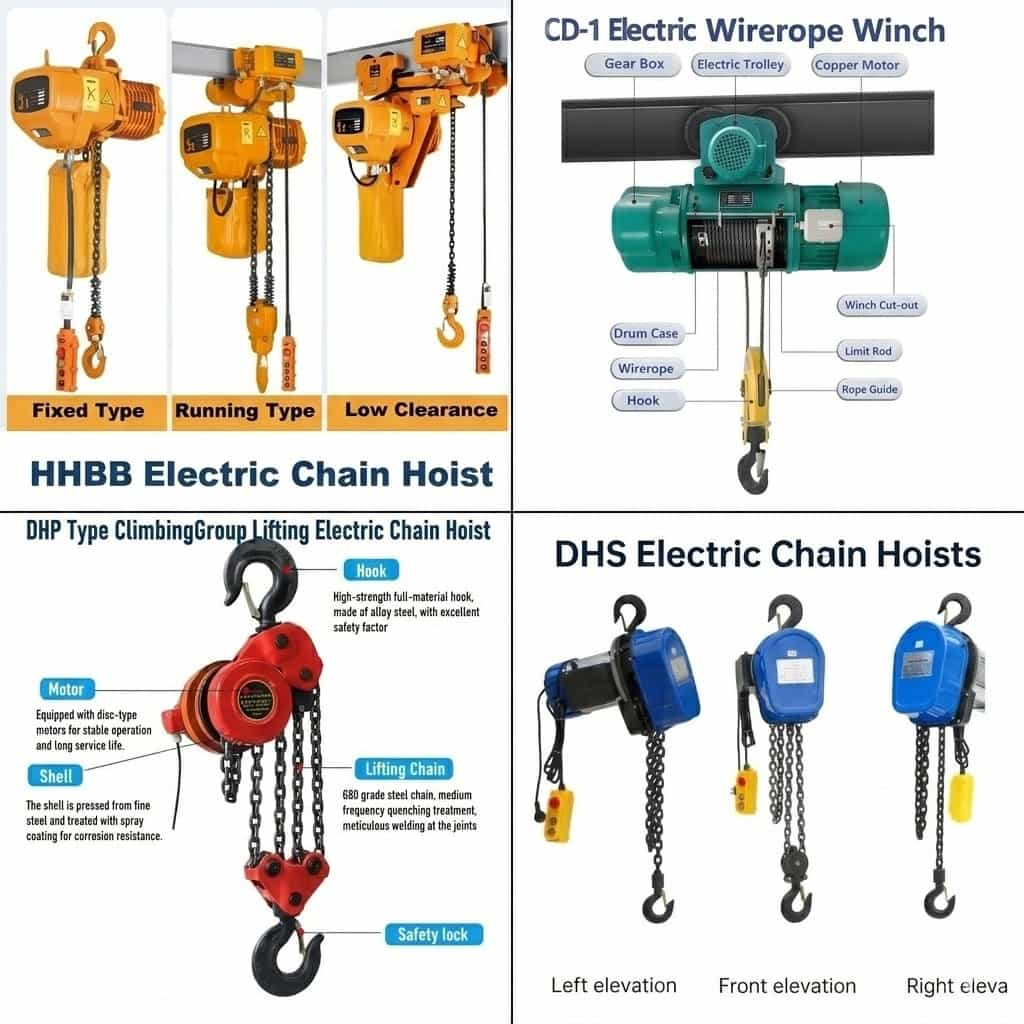
The key factors in selecting industrial electric hoists include load capacity, certification standards, and specific application scenarios. Making a comprehensive assessment based on actual needs can effectively improve operational efficiency and ensure safety.

Chain Block Electric Hoist: Typically handles 0.1 to 20 tons, with high-strength alloy chain designs supporting even higher loads.
Plate Chain Electric Hoist: Lower capacity, usually 0.1 to 3 tons, ideal for light-load, high-frequency operations.
√ Recommendation: For loads ≥5 tons or frequent operation, prioritize wire rope type; for ≤5 tons with space constraints, chain block offers greater compactness and flexibility.
Explosive Environments: In chemical, oil & gas, or flammable areas, equipment must have ExdⅡCT4 or higher explosion-proof rating, and pass IP54 or higher protection level certification.
Special Equipment Regulation: Electric hoists used independently with capacity ≥3 tons fall under special equipment supervision and must obtain GB/T 28264-2017 certification.
× Risk Alert: Some manufacturers may falsify credentials. It is recommended to conduct on-site inspections and verify customer cases and documentation.
Lift Height: Standard range is 3–30 meters; custom options exceed 150 meters—determine effective lift based on facility clear height.
Duty Class: ISO M3 to M8; for high-frequency use, M4 or above is recommended to extend service life.
Intelligent Trends: Starting 2025, new standards require Level 4 systems to feature AI obstacle avoidance and real-time alerts, reducing maintenance costs by 25%–35%.
1. Load Capacity: Matching Actual Lifting Requirements
Lifting capacity is the primary consideration in hoist selection, with significant differences across types:
Wire Rope Electric Hoist: Standard capacity ranges from 0.1 to 10 tons, with special custom models exceeding 63 tons, suitable for heavy-duty industrial applications .Chain Block Electric Hoist: Typically handles 0.1 to 20 tons, with high-strength alloy chain designs supporting even higher loads.
Plate Chain Electric Hoist: Lower capacity, usually 0.1 to 3 tons, ideal for light-load, high-frequency operations.
√ Recommendation: For loads ≥5 tons or frequent operation, prioritize wire rope type; for ≤5 tons with space constraints, chain block offers greater compactness and flexibility.
2. Certifications and Safety Standards: Ensuring Compliance
Different working conditions demand varying safety levels. Key certifications include:
General Standards: Must comply with GB/T 3811-2008 "Crane Design Code" and GB 18613-2020 energy efficiency standards.Explosive Environments: In chemical, oil & gas, or flammable areas, equipment must have ExdⅡCT4 or higher explosion-proof rating, and pass IP54 or higher protection level certification.
Special Equipment Regulation: Electric hoists used independently with capacity ≥3 tons fall under special equipment supervision and must obtain GB/T 28264-2017 certification.
× Risk Alert: Some manufacturers may falsify credentials. It is recommended to conduct on-site inspections and verify customer cases and documentation.
3. Application Scenarios: Precise Matching to Work Environment
| Application Scenario | Recommended Type | Key Features |
| Manufacturing Assembly Lines | Wire Rope + Variable Frequency Control | Positioning accuracy up to ±1mm, ideal for precision mold handling |
| Construction Sites / Port Terminals | High-Capacity Wire Rope Hoist | Compatible with tower or portal cranes for efficient vertical transport |
| Automated Warehousing & Logistics | Chain Block + Rail System | Integrates with cloud management, supports 72-hour fault early warning |
| Maintenance Shops / Equipment Repair | Medium-to-Low Tonnage Chain Block | Flexible operation for motor, gearbox disassembly |
| Coal Mines / Chemical Plants / Oil Tanks | Explosion-Proof Chain Block | Dual-circuit braking system with emergency response within 0.2 seconds |
Special Environment Tips:
High-temperature environments (e.g., steel plants): Use YHⅡ-type brake systems rated for 200°C.Humid/corrosive environments: Prefer alloy chains with anti-corrosion coating.
4. Other Key Parameter Recommendations
Power Supply Compatibility: Confirm on-site power is single-phase 220V or three-phase 380V to avoid startup failure.Lift Height: Standard range is 3–30 meters; custom options exceed 150 meters—determine effective lift based on facility clear height.
Duty Class: ISO M3 to M8; for high-frequency use, M4 or above is recommended to extend service life.
Intelligent Trends: Starting 2025, new standards require Level 4 systems to feature AI obstacle avoidance and real-time alerts, reducing maintenance costs by 25%–35%.


 sales@tieshouqizhong.com
 +8615132261111
 Alice Zhang
 Kang Wang
 Joyce Yang
 Home
Home WhatsApp
 Email
Email